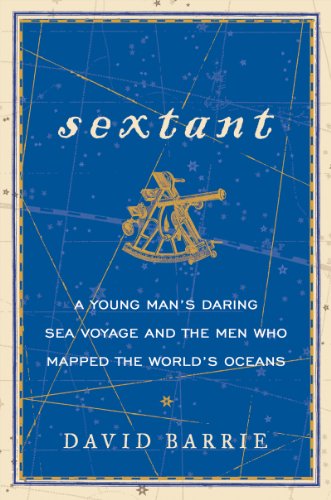
Browse Book Online Free Sextant: A Young Man's Daring Sea Voyage and the Men Who Mapped the World's Oceans
Reading Online: Click Here
Download: Get Here Free!
Amazon.com Review

David Barrie The Story Behind Sextant
The story of Sextant began in 1973 when a family friend - Colin McMullen - asked me to help him sail his 35-foot yacht back across the Atlantic from America. I was nineteen and it was such an exciting offer that I immediately accepted. After cruising up the coast of Maine, we set sail from Halifax, Nova Scotia, at the end of July.
In those days the only one safe way to navigate a small boat across an ocean was with a sextant to measure the heights of the sun and stars above the horizon. You also needed a chronometer to determine the exact time of each sight. This was exactly how Captain Cook navigated back in the 1770s.
I learned a lot during that 24-day voyage, and not just about celestial navigation. I was sometimes frightened, often cold, wet and uncomfortable, but there were also many moments of delight and exaltation. The majestic spectacle of the black immensity of the night sky sparkling from horizon to horizon with the undimmed light of countless stars was astounding. And to fix your position in mid-ocean by the light of the sun and stars is a truly sublime experience.
So one of my aims in writing this book was simply to tell the story of that life-changing voyage, of how I learned to use a sextant. Also 1973 was the year the US armed forces began developing the satellite navigation system we now know as GPS. At its heart is a network of satellites in precisely determined orbits each carrying its own atomic clock. A GPS receiver picks up the faint signals from these satellites and a computer chip uses them to determine its position. Since 2000 anyone with a GPS receiver has been able to fix his or her position to within a few meters.
The golden age of celestial navigation has now come to an end, but for two hundred years or more the sextant was an indispensable navigational tool. So my second aim is to celebrate the achievements of the mathematicians, astronomers and instrument-makers who made this great navigational breakthrough possible, and to illuminate the crucial role the sextant played in it.
I also wanted to commemorate the extraordinary men who put the sextant to such good use in exploring and mapping the world. Some, like Cook, are still famous but many have been almost forgotten. I tell the remarkable tales of just a few of these heroic mariners - including Bougainville, La Prouse, Vancouver, Flinders and FitzRoy.
And I could not resist including accounts of three astonishing small boat voyages - by William Bligh, Joshua Slocum and Frank Worsley - the success of which depended on accurate celestial navigation. Sextant is an elegy to a technology that has now all but vanished.
It shows how much we owe to this elegant instrument and


No comments:
Post a Comment