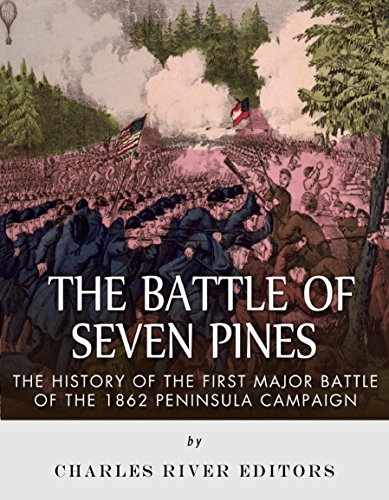
Read Book Online Free The Battle of Seven Pines: The History of the First Major Battle of the 1862 Peninsula Campaign
Read Online: Click Here
Download: Get Here Free!
Product Description
*Includes pictures
*Includes accounts of the battle written by generals
*Includes a table of contents
As Union commander George McClellan moved the Army of the Potomac up the Peninsula in early 1862, the Union army still had a nearly 2-1 advantage in manpower, so Army of Northern Virginia commander Joseph E. Johnston continued to gradually pull his troops back to a line of defense nearer Richmond as McClellan advanced. In conjunction, the Union Navy began moving its operations further up the James River, until it could get within 7 miles of the Confederate capital before being opposed by a Southern fort.
McClellan continued to attempt to turn Johnstons flank, until the two armies were facing each other along the Chickahominy River. At this point, the Union army was close enough to Richmond that they could see the citys church steeples, but they would come no closer. By the end of May, Stonewall Jackson had startlingly defeated three separate Northern armies in the Valley, inducing Lincoln to hold back the I Corps from McClellan. When McClellan was forced to extend his line north to link up with troops that he expected to be sent overland to him, Johnston learned that McClellan was moving along the Chickahominy River.
It was at this point that Johnston got uncharacteristically aggressive. Johnston had run out of breathing space for his army, and he believed McClellan was seeking to link up with McDowells forces. Moreover, about a third of McClellans army was south of the river, while the other parts of the army were still north of it, offering Johnston an enticing target. After a quick deluge turned the river into a rushing torrent that would make it impossible or the Union army to link back up or aid each other, Johnston drew up a very complex plan of attack for different wings of his army, and struck at the Army of the Potomac at the Battle of Seven Pines on May 31, 1862.
Like Union general Irvin McDowells plan for First Bull Run, the plan proved too complicated for Johnstons army to execute, and after a day of bloody fighting little was accomplished from a technical standpoint. At one point during the Battle of Seven Pines, Confederates under General James Longstreet marched in the wrong direction down the wrong road, causing congestion and confusion among other Confederate units and ultimately weakening the effectiveness of the massive Confederate counterattack launched against McClellan. Johnston wrote in his memoirs, The operations of the Confederate troops in this battle were very much retarded by the dense woods and thickets that covered the ground, and by the deep mud and broad ponds of rain-water, in many places more than knee-deep, through which they had to struggle.
Nonetheless, by the time the fighting was finished, nearly 40,000 had been engaged on both sides, and it was the biggest battle in the Eastern theater to date (second only to Shiloh at the time). Although it was inconclusive, McClellan was rattled by the attack, and


No comments:
Post a Comment