Read Book Online Free Naval War of 1812-1815: Foundation of America's Maritime Might
Product Description
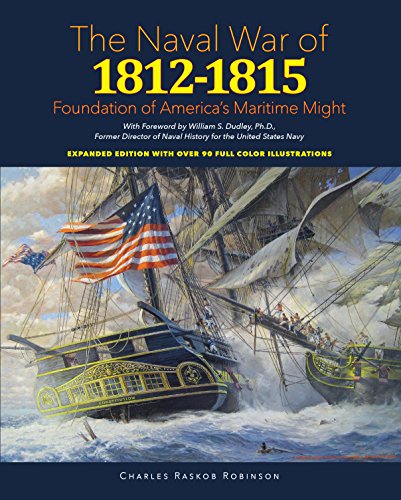
This is the exciting story about how the young American Republic established the United States Navy, Marine Corps and Revenue Cutter Service (the predecessor to the Coast Guard), designed and built the most powerful class of frigate in the world, trained its seamen in gunnery and naval warfare and gained battle experience in the Quasi-War with France in 1798-1800 and the Barbary War (Shores of Tripoli) in 1801-1805. The United States was a neutral nation in a world where European powers were locked in a death struggle. When it could no longer tolerate interference with its maritime commerce and the impressment of its sailors into the Royal Navy, it declared war against Great Britain in the Second War of Independence in 1812. Lessons learned then are still relevant in todays very uncertain world.
In this era of fighting sail when ships were made of wood and men of iron, the narrator takes us into the action of the three principal theaters of the conflict: The war on blue water of the Atlantic, Pacific and Indian Oceans; the war on the lakes along the northern border with British North America (Canada); and the war on brown water of American bays, sounds, estuaries and rivers from Maine to New Orleans. Each chapter bristles with action.
On blue water the young Navy, with less than two-dozen ships, took on the mightiest, the Royal Navy, with a fleet of over 600. To the worlds amazement, in the first eight months of the war five single-ship actions occurred and in every one the Americans bested the British. The names ring through history: The American heavy frigate Constitution (Old Ironsides the oldest commissioned ship in the world still afloat) and the smaller frigates Chesapeake, Constellation and Essex (which first made the United States a two-ocean Navy as it preyed on the British in the Pacific) and smaller warships, Enterprise, Wasp, Hornet, and Argus. British ships also left their mark on history: Guerriere, Macedonian, Java, Shannon, Phoebe, Endymion, Orpheus, Borer, the 74gun Ramillies and many more. As the wars in Europe ended, the British turned to deal with the troublesome Americans and blockaded the entire country, causing near economic collapse. And yet daring crews still ran the blockade and fast American privateers continued to harass.
In the war on the lakes, the British North Americans thwarted American attempts to invade Canada and began to attack American territory. Over time, it was the dramatic struggle by both sides to build and man inland navies that dictated the outcome: the American victory at the Battle of Lake Erie and the following British defeat in the Battle of the Thames where the great Native American leader and ally of the British, Tecumseh, died. However, many battles and actions preceded these events: Sackets Harbor, Kingston, Fort George, the Burning of York, the Burlington Races, Stoney Creek, Chateauquay, and Cryslers Farm. Subsequently, the decisive victory by the American Navy at the Battle of Lake Champlain brought
Read Online: Click Here
Download: Get Here Free!


No comments:
Post a Comment